
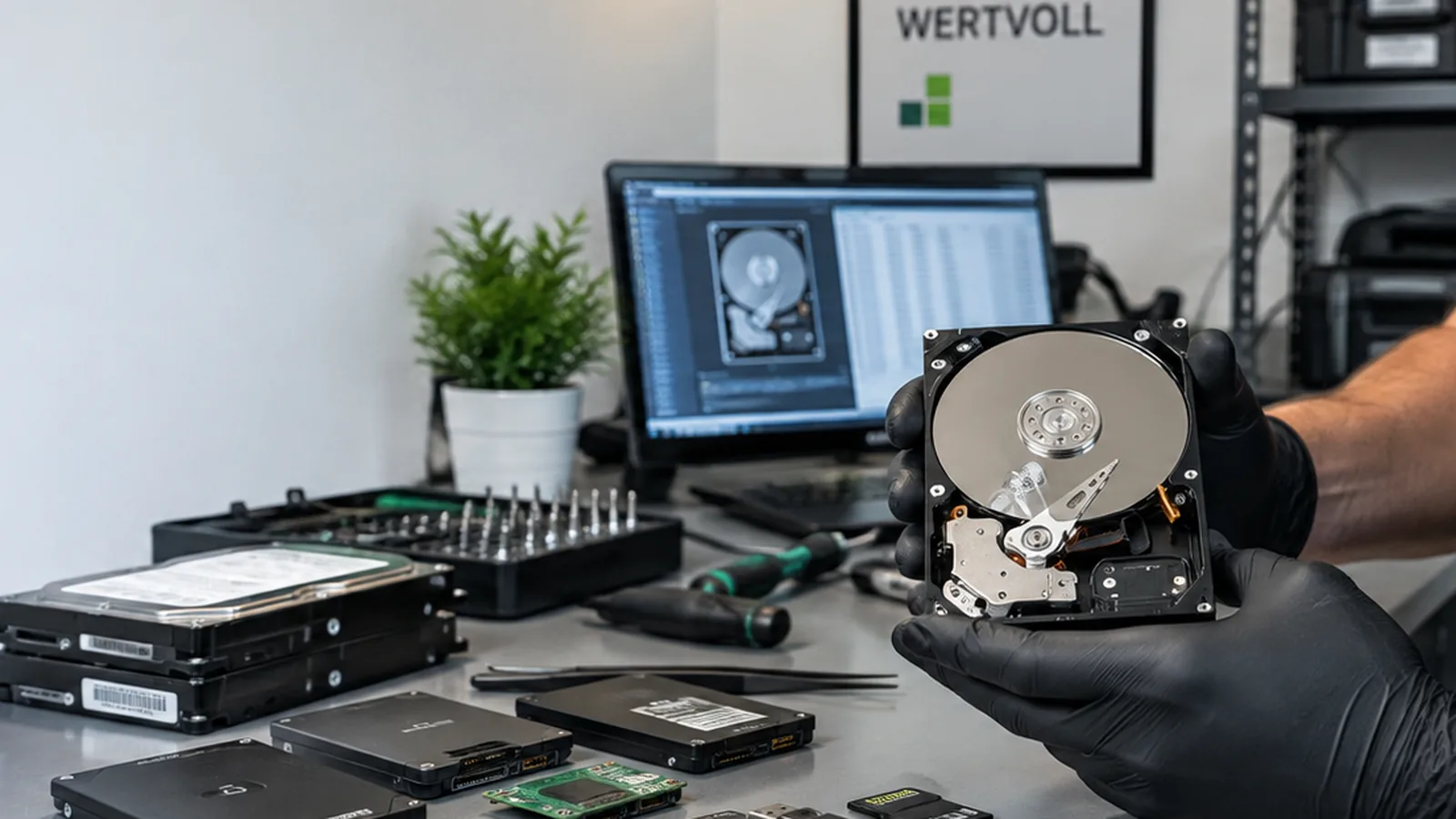
Data recovery for companies
When a server, a RAID or a NAS fails, the hardware is not the problem. The time until work can continue is.
Mon–Fri 8 am–6 pm · emergencies and pick-up by arrangement
For private customers it is usually about memories. For a business it is about the working day: the merchandise system that will not start, the accounts a week before the deadline, the order database six workstations depend on. The value of the medium no longer matters – what counts is how many hours pass until work resumes, and whether something happens in between that makes recovery impossible.
That is why the procedure for companies looks different. You get binding figures in advance, an order of work based on operational urgency rather than file size, one person to talk to instead of a ticket queue, and an invoice after the job – without prepayment.
The first hours decide more than everything after them
The most common damage does not happen during the failure but in the hours that follow. A RAID 5 loses a drive, the controller starts rebuilding onto a spare, and because a second drive has been weak for a long time the process aborts halfway – at which point the user data has partly been overwritten. Or someone confirms the file system repair the operating system suggests, and the management structures are rewritten.
Neither can be undone. So the practically most important advice for an emergency is unspectacular: shut the system down, do not let anything rebuild, do not confirm any repair, note the order and labelling of the drives – then call. A system that is switched off does not get worse. One that keeps trying to heal itself does.
We will go through the situation with you on the phone and say openly whether the case belongs in a lab or whether your own IT can solve it faster from an existing backup. That assessment costs nothing, even when no order comes out of it.
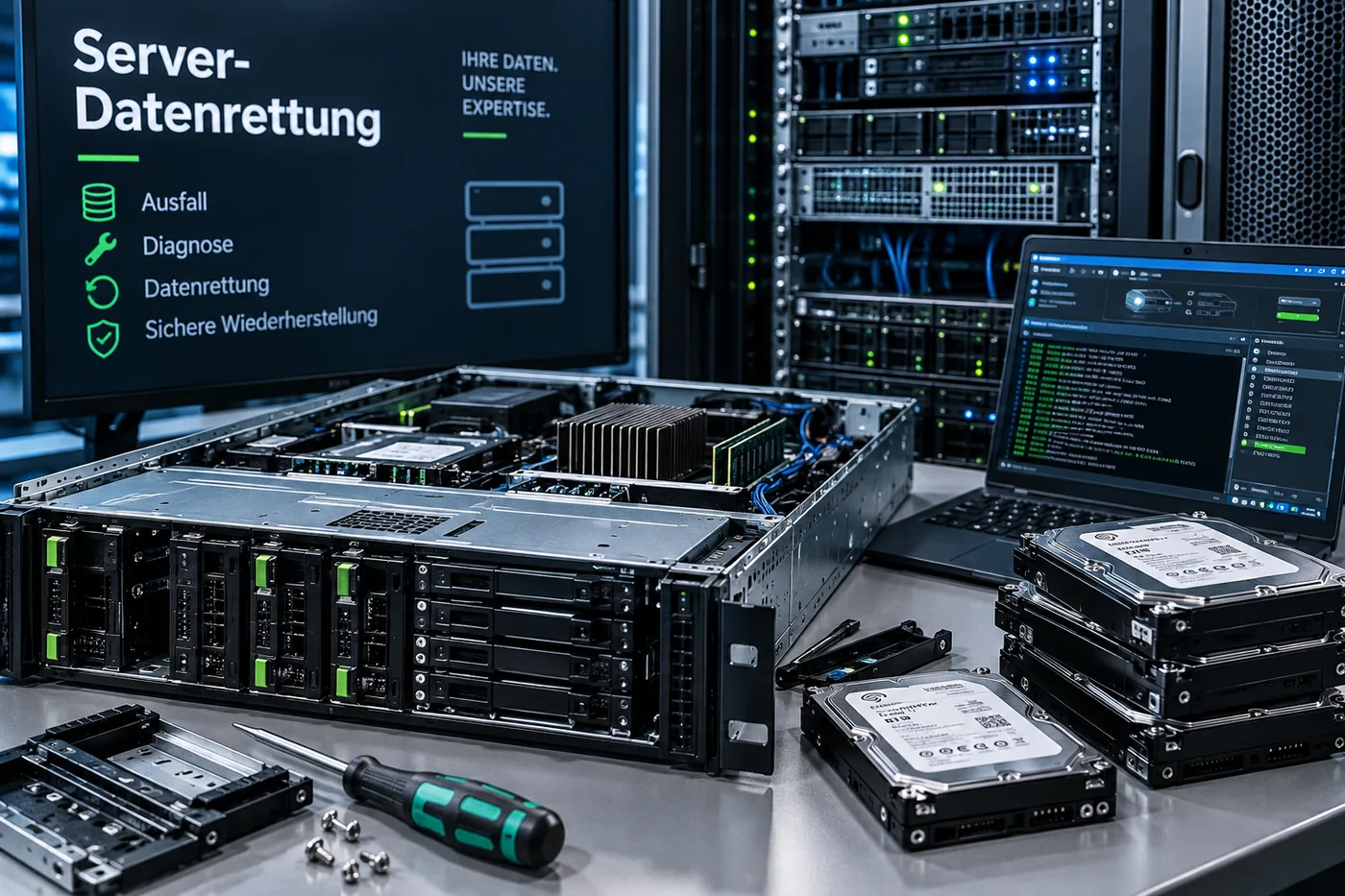
Systems we work on
Everything that is actually in use in small and medium-sized organisations – from a single server in a side room to storage in a data centre.
Servers, RAID and NAS
RAID 0, 1, 5, 6, 10 and JBOD, hardware controllers from Dell, HPE, Lenovo and Fujitsu as well as software RAID. NAS systems from QNAP and Synology, including Btrfs, ext4 and ZFS. Drive order, block size, parity and start offset are reconstructed before a readable file system reappears.
Virtual machines
VMware (VMDK), Hyper-V (VHD and VHDX) and Proxmox. Often the underlying storage is damaged while the image files themselves are largely intact – they are then extracted from the raw data and the file systems inside evaluated separately.
Databases and mailboxes
Files from SQL Server and MySQL, Exchange databases and PST archives. We recover the files and check that they open; putting them back into your application is done by your IT or your system house, in direct contact with us if that helps.
Tape and SAN storage
LTO cartridges from backup runs and media from SAN environments. These cases are discussed before handover, because effort and approach depend heavily on the backup software and the number of media involved.
How the commercial side works
Four points that make the difference in day-to-day operations.
Quote before work starts
After the analysis you receive a binding fixed price and an overview of the data found – a basis that can be put in front of management or procurement.
Invoice without prepayment
Payment is due after completion. We record your purchase order or cost centre so the invoice passes your accounts department without queries.
Collection and return
In North Rhine-Westphalia, Rhineland-Palatinate, Hesse and northern Baden-Württemberg we collect media and whole machines. Beyond that, insured shipping is usually overnight.
One point of contact
You speak to the person working on your case. Questions about order, status and handover do not travel through several layers.
Confidentiality, data protection and records
A medium from a company almost always contains personal data: customer files, personnel records, patient data, correspondence. Under data protection law you remain responsible for it, including while the medium is with us. Art. 28 GDPR provides for a written agreement between us for precisely this situation – we can supply one, or sign yours. In addition we sign a confidentiality agreement on request.
In practice this means: we take note of contents only as far as the work and the file list require. Media and working copies are kept locked away, access is limited to the people handling the case, and after your release image and working copy are deleted. We confirm that deletion in writing with a date if you need it for your own data protection records.
If a defective medium should not come back but disappear, tell us. We then agree in advance how destruction is to be carried out and what documentation you require.
Who commissions us
A cross-section of the organisations our orders come from – almost always houses without their own storage specialists, but with data that cannot be created again.
Tax advisers and law firms
Client files and practice systems on a firm server
Medical practices and clinics
Practice management and imaging archives on the NAS
Architecture and engineering
Plan revisions and CAD projects on RAID systems
Mechanical engineering
Control data, drawings, order management
Agencies, film and photography
Large project archives and editing data
Trades and crafts businesses
Quotes, calculations and photo documentation
Logistics and haulage
Dispatch and consignment data in day-to-day operation
Retail and wholesale
Merchandise management, till and stock data
Hotels and hospitality
Booking, till and personnel data
Education and research
Measurement series that cannot be repeated
Property management
Property files, statements and contract documents
Pharmacies and laboratories
Stock management and results with retention duties
Two groups with their own rules
Frequently asked questions
Do we have to pay in advance?
No. Companies and public bodies are invoiced after completion. The analysis is free, the quote is binding, and work starts only after your release.
Do you sign a data processing agreement?
Yes. The media that reach us regularly hold personal data of your customers, patients or staff. Art. 28 GDPR requires a written agreement for exactly this situation. We can provide one, or we sign yours.
How fast is it when operations are down?
The first hour counts. Call before you try anything. Within our region we often collect the medium or the whole server the same working day, and the analysis starts as soon as it arrives.
Can you prioritise individual files?
Yes, and for businesses that is usually the sensible route. Tell us which directory or database is needed first and it will be read out in that order so you can work again sooner.
Do we get documentation for our records?
Yes. You receive an overview of the recovered data and, on request, written confirmation that image and working copy have been deleted.
Do you work outside our business hours?
By arrangement, yes. For cases that cannot wait for a weekend to pass there is the express analysis; the conditions are in the price overview.
Relevant services
Server recovery
Databases, virtual machines, shared folders
RAID recovery
Reconstructing order, block size and parity
NAS recovery
QNAP, Synology, Btrfs and ext4
Hard drive recovery
Head crash, seized motor, firmware faults
SSD recovery
Controller failure, firmware, drives not detected
Laptop & PC
Device will not start, operating system damaged
External hard drives
Fall damage, failed USB bridge, encryption
All services
All storage media and failure patterns at a glance
Your system is down? Get in touch before anything is rebuilt.
Ten minutes on the phone often save the most expensive part of the damage.